A recount text is a text which tells about things happening in the past.
AIMS/GOALS
To recall someone's experience.
To inform someone about a past event.
TEXT STRUCTURE
Orientation
Telling about setting of place and time, and the people involved.
Events
Telling about the events occur in the story. EXAMPLE
A Trip to the Baliem Valley
Last vacation I decided to do a little
adventure by visiting Dani tribe in Baliem valley.
First,
I enjoyed the Baliem Cultural Festival at Muliama village about 20 kilometers
from Wamena. The festival lasted in
several days. People of Dani were
singing, dancing, and playing their traditional music during the festival. They decorated their faces with pig grease,
clay, ash and fur. They clutched bows,
arrows and spears as they feinted and charged each other. However, no blood was shed-it was all
intended only as a threatening show of force.
When
the festival was over, I decided to join a trekking trip to the spectacular
villages of Dani. The trip gave me an
opportunity to see the real Dani lifestyle.
I saw amazing wooden bridges across the fast flowing mountain rivers. I
also learned that men and women live in separate traditional houses. Another amazing thing that I noticed was
people with parts of fingers missing as the result of a custom where both men
and women may cut off fingers if bereaved by the loss of loved one.
My eight days visit to Baliem valley gave me a deep
impression of the richness of Indonesian’s culture. (Taken from: Mandiri _ Practice Your English, Penerbit Erlangga)
If you want to be a better speaker, then develop some good storytelling techniques. There are many ways to express a story, but storytelling is a one-time experience shared between the listener and the storyteller. Storytelling is created anew every time you speak. I’ve listed nine storytelling tips for you to think about whenever you want to create a storytelling experience.
1. You need to tell stories that you like.💗
Choose a story you like when telling for kids at the library, for a sacred setting or to leaders of business or nonprofit groups. There will be many stories for any situation you are in. Choose a story that you can understand and enjoy.
2. Take the time to prepare.⏰
Take the time to learn how to tell a story. Don’t just dive into telling a story you have heard only once. Break the story into parts. Practice with a recording device and a gentle-yet-truthful friend who can hear your first attempts.
3. Do not hesitate to remove the slow parts of your story.💭
It’s not unusual for first-time storytellers to try to tell every piece of a story. Storytelling occurs in the moment so not every detail has to be included each time. Ask yourself, "Do I need to tell this piece of the story this time? Is it critical?"
4. Use a strong and confident voice. 🔊
Being prepared will make you confident. Speak with clarity and confidence. Enunciate and project your voice towards the listeners.
5. Use good pacing. 👧
When you are confident, you will not be in a hurry. You want to speak slow enough so that the story is easily absorbed by the audience but do not speak so slowly that their minds check out of the room.
6. Do not pass on the microphone.💬
In almost all cases, you will need to use a microphone. This is respectful to your audience. The most seasoned speaker might get away without a microphone for groups under 25 folks. Beginners, use the mic unless you are speaking to a few folks at a luncheon round-table event.
7. Use eye-contact with your listeners. 👀
Your eye contact is a gift to the listener. It always amazes me how a fleeting moment of eye contact can make an audience member come to me and say, "I felt like you were talking to me personally."
8. Make your gestures easy and calm. 💁
"You looked so confident up there. I never know what to do with my hands." When people say this to me, I am thankful that I took the time to prepare which gestures I would use and when I would use them. Your gestures should be natural and relaxed. Take the time to decide these ahead of time.
9. Avoid the "moral of the story" finishes. 🙋
Stories teach. Storytelling is a most effective way to teach with story. Let the story speak to the audience in its own way and skip the need to tell them what to think. If you must do the "moral" of a story, ask your audience first to tell you what they think. Their answers might teach you.
I’ve shared 9 storytelling tips to help you create a story with good storytelling. If you are an experienced speaker, choose one of these tips to help you be a better public speaker. If you are new to speaking, just concentrate on areas that you need some fine-tuning.
Once upon a time, on the banks of a river, Turtle played her flute. When Turtle played, all the animals listened. Lions, elephants, butterflies, snakes and monkeys danced to Turtle’s music.
One day a man heard Turtle’s music.
“Ahh,” he thought, “that must be Turtle making music. Turtle would taste very good right now.” So he called out, “Turtle! Show me your beautiful flute.” Turtle slowly walked to the door and held out her flute. But the moment the man saw Turtle, he grabbed her by the neck and began to run. Turtle tried to cry for help, but she couldn’t make a sound. She closed her eyes, holding tightly to her flute for good luck.
When the man reached his hut, he put Turtle into a cage and shut it. Then he turned to his children. “Don’t let Turtle out of her cage.” And off he went to the fields. The children began to play outside. Turtle sat very still inside her cage, thinking about the father’s words. She began to play a sweet tune on her flute, and the children ran to the cage.
“Is that you playing, Turtle?” they asked, their eyes wide with wonder. “Yes,” Turtle said. She kept on playing, for she could see the children were delighted. At last she stopped. “I can dance even better than I can play,” she said. “Would you like to see?” “Oh, please!” the little boy cried. “I’ll show you how to dance and play at the same time,” said Turtle, “but you must open the cage. There is no room in here.”
So the little boy opened the cage and Turtle began to dance and play. The children laughed and clapped their hands, for never had they seen such a wonderful thing. Then Turtle stopped. “Don’t stop!” the children cried. “Oh,” Turtle groaned, “my legs are stiff. If I could just walk a little bit to loosen them ...”
“Don’t go too far,” the little girl cautioned. “Come right back.” “Never fear,” said Turtle. “You wait right here.” Turtle crawled off toward the jungle. The moment she was out of sight, she raced all the way back to her house. Nobody ever found Turtle again. But to this day, if you stretch your ear, you can listen to the sweet sound of a flute in the forest. (Taken from www.bookbox.com)
😊Enjoy the video, guys!😉
Perhaps you want to listen to the MP3. Here it is.👂
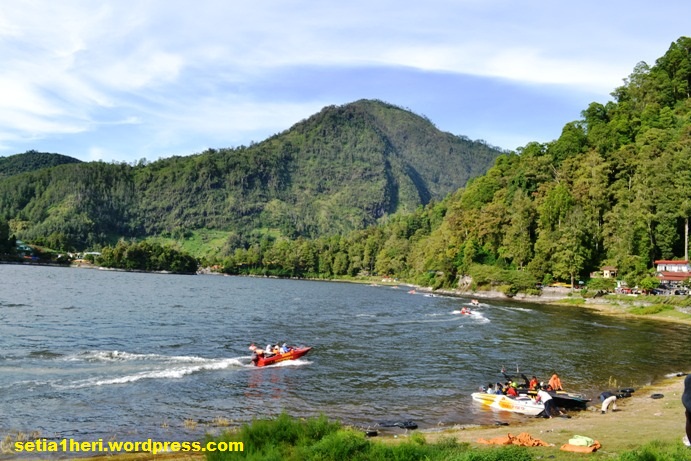
Telaga Sarangan is
the name of a lake in East Java. The
beautiful lake is located in Magetan regency of East Java. It is in the slope of Lawu Mountain.
Green
hills and cool breeze make the lake more beautiful. Tourists can enjoy the beauty of the lake
using speedboats or pedaled boat (becak
air). There are 51 speedboats and 13
pedaled boats to use. Tourists can also
use horses to go around the bank of the lake.
It takes about twenty minutes to go around on a horse back.
Tourists can spend the night in
hotels near the lake. There are about
forty five hotels and eighteen inns.
From the balcony of the hotels, tourists can enjoy the green panorama of
the hills, and the sparkling green lake. Before going home, tourists can buy
souvenirs in the shops near the hotels.
They can purchase bamboo handicrafts, leather shoes, and special food of
Magetan. (Taken from BUPENA - Penerbit Erlangga).

 To show a specific place, location or position.




 Posts
Posts

